80 Years of Exploration of the Clamouse Cave (1945–2025)
A human, scientific, and tourist adventure unlike any other in France.
Located in the heart of the Hérault Gorges, a few hundred meters upstream from the famous Pont du Diable, the Clamouse Cave is today one of the most remarkable natural sites in southern France. But behind its current appeal as a tourist destination lies a rich history spanning four decades of exploration, development, and scientific research, making this site a rare case study in the world of underground tourism.
A look back at the Clamouse saga, from the first speleological explorations in 1945 to today’s challenges in heritage preservation and climate action.
1945: The Chance Discovery of a Forgotten World
On August 5, 1945, a team from the Montpellier Speleological Club, led by Maurice Laures, discovered the cave’s natural entrance during an exceptional period of severe low water levels. The Vaucluse siphon, which normally blocks access, had temporarily receded, allowing the cavers to cross this barrier that had been impassable for millennia.
“Fortune smiled on the pioneers long before the invention of cave diving. ”
In one week, they explored 350 meters of generally submerged passages. By the end of the following month, the network had reached 600 meters, with access to the upper fossilized sections, rich in concretions.”
1947–1965: Scientific Recognition and Initial Development Projects
1947 marked the first major recognition, with the Speleology Prize being awarded to the Montpellier Speleo-Club for this exceptional discovery. At that time, the karst system comprised more than 6 kilometers of identified passages. Its source lies in the Causse du Larzac, feeding a spectacular resurgence near Saint-Guilhem-le-Désert.
1965: After twenty years of preparatory work, the cave officially opened to the public. A 1-kilometer tourist trail was established, allowing visitors to explore iconic chambers such as the Salle des Sables, the Niagara Rouge, and the Canyon Souterrain without having to follow the explorers’ original technical route.
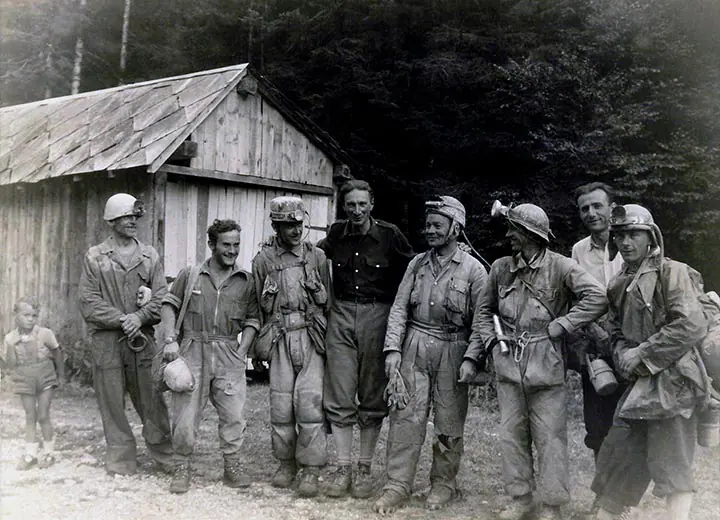
The Montpellier Caving Club
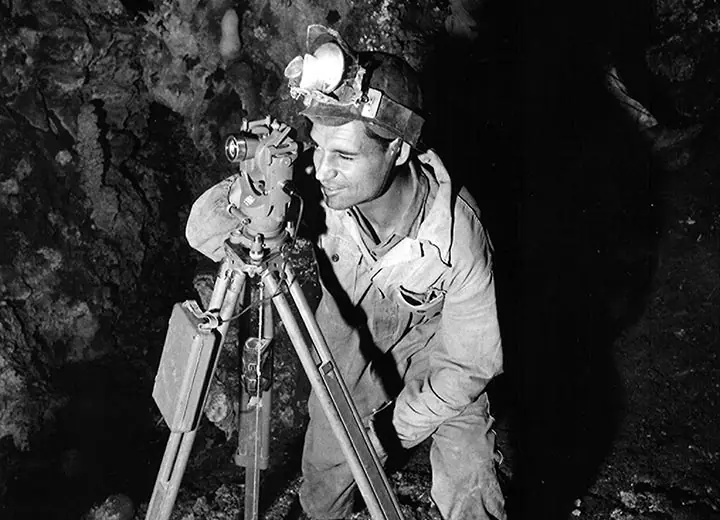
Early surveys conducted by Georges Garby in the Clamouse Cave
1970–1990: Experimentation and Cultural Visibility
During this period, the cave became a prime setting for research on isolation and circadian rhythms.
1989: The French television series “L’Or du Diable” was filmed in the mine tunnels, giving the site unprecedented media exposure.
2000: The Michel Siffre Experiment
Michel Siffre, a French pioneer in research on temporal isolation, spent more than two months in the depths of Clamouse. This experiment contributed to scientific understanding of human biological mechanisms in a closed underground environment.
2010: Environmental Technological Transition
A European first: the Clamouse Cave has become the first underground site in Europe to be fully equipped with an LED lighting system. This innovation significantly reduces energy consumption while protecting the fragile formations from thermal damage caused by traditional lighting systems.
2013–present: Cutting-edge climate research
September 2013: Dominique Genty, Research Director at the Laboratory of Climate and Environmental Sciences (CNRS), installed a permanent monitoring system in the cave. This voluntary initiative, funded by the Clamouse administration, aims to advance our understanding of the underground environment.
Key finding: The concretions in the “Le Cimetière” chamber have been dated to 376,000 years ago. These specimens constitute veritable paleoclimatic archives comparable to ice cores, making it possible to reconstruct climatic variations over several glacial-interglacial cycles.
Since 2014: Continuous measurements have yielded valuable data on paleoclimates and the cave’s internal environmental factors, establishing Clamouse as a natural laboratory for climate science.
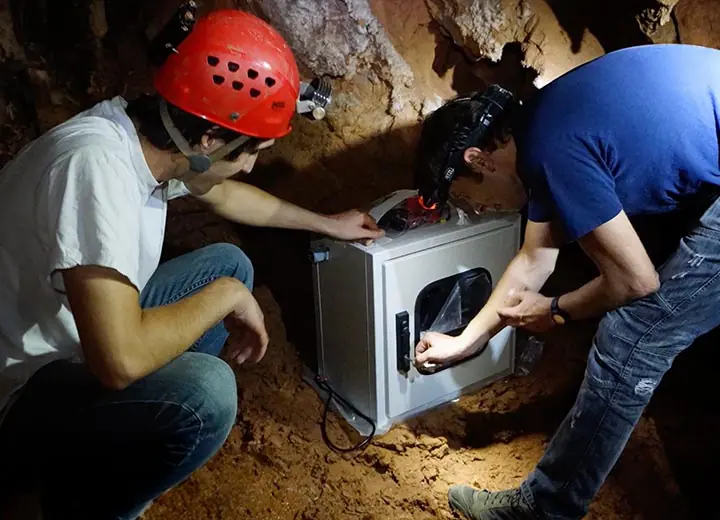
Installation of a weather monitoring device inside the cave.
2010: Today: A Certified Site Committed to CSR
Designated a protected site by the Ministry of Ecology and Sustainable Development, the Clamouse Cave welcomes approximately 150,000 visitors annually.
Current technical specifications:
- Total length of the explored network: ~6 km
- Marked scenic trail: 1,000 m
- Average visit duration: 60 minutes
- Elevation of the resurgence: 75 m above sea level
- Total elevation gain: 120 m
- Constant indoor temperature: 15°C
Outlook: Between Heritage Preservation and Climate Vulnerability
The cave now faces new challenges:
- Impacts of Climate Change on the Hydrological Regimes Feeding the Resurgence
- Preserving the concretions in the face of tourist traffic
- Inclusion in the Grand Site de France® Saint-Guilhem-le-Désert and the Hérault Gorges
Ongoing research aims to model the effects of external thermal anomalies on the internal stability of the karst environment, with direct implications for the sustainable management of the site.
Conclusion
From its chance discovery in 1945 to the climate laboratories of 2025, the Clamouse Cave illustrates the evolution of the relationship between natural heritage, scientific research, and tourism development. What began as an adventurous caving expedition has evolved into an integrated ecosystem of conservation, research, and cultural sharing.
Clamouse’s future now hinges on its ability to balance public access with rigorous protection of these unique sedimentary archives, which serve as true records of our planet’s climate history.
Stay informed
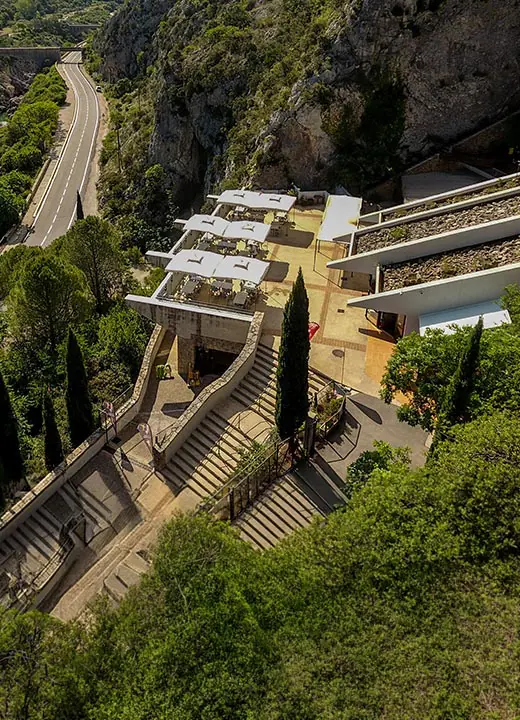
The Clamouse Cave, a pioneer in sustainable tourism in Occitanie
For more than ten years, the Clamouse Cave has been committed to preserving natural heritage and promoting social responsibility.

ConcertSolar Punk
Clamouse is transforming into a space for sonic exploration: join us for SOLARPUNK: The Awakening of the Senses.
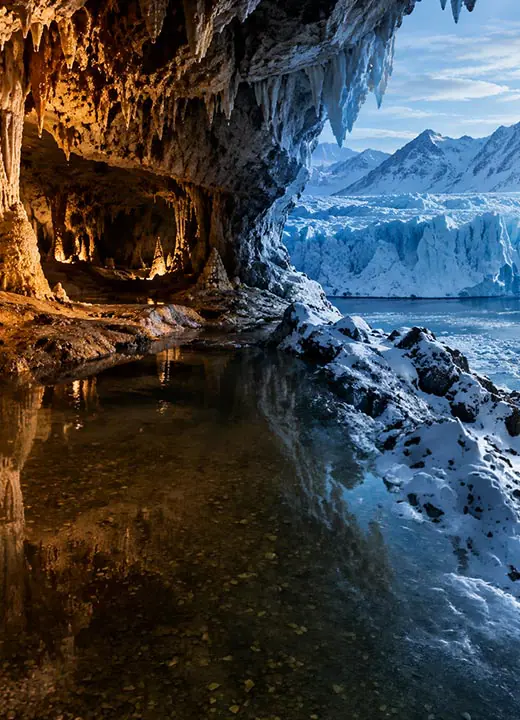
The caves,Witnesses to the Climates
Over the course of thousands of years, stalagmites and other mineral formations record changes in the environment.