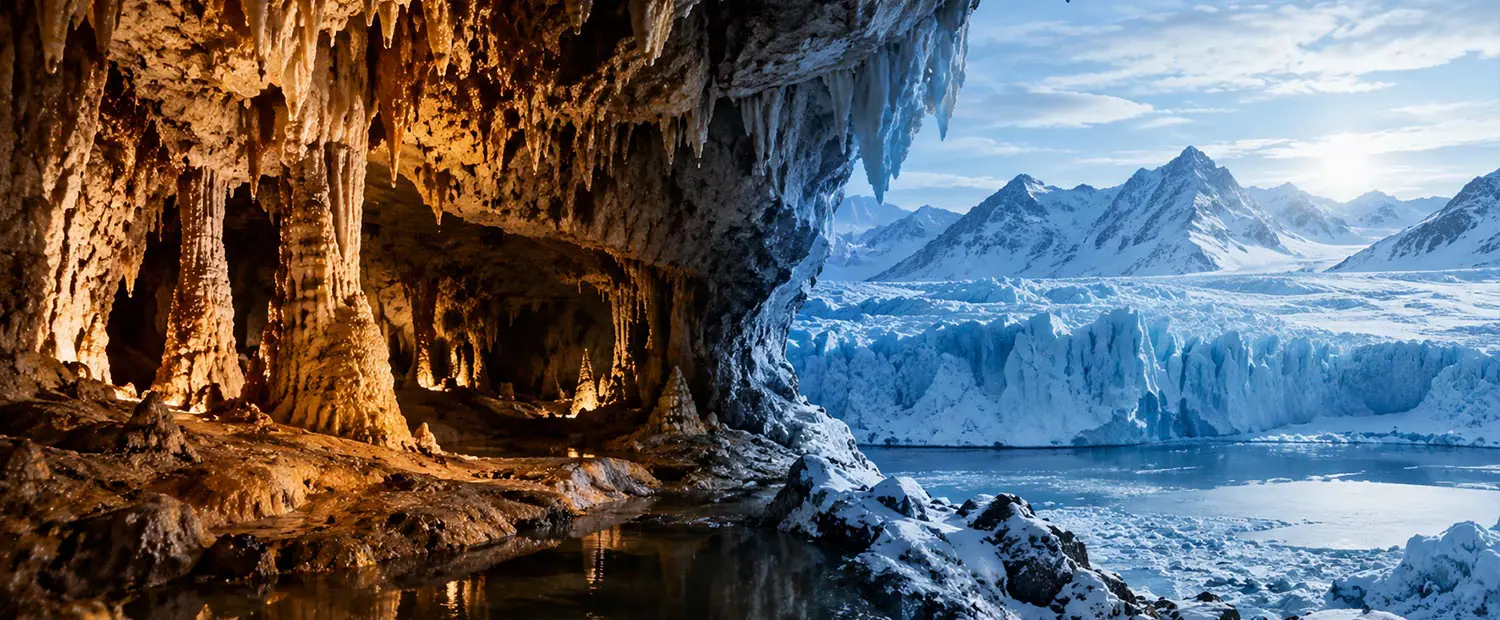
The caves, Witnesses to the Climates
How does the climate influence the formation of concretions?
The formation of cave deposits is closely linked to the conditions prevailing on the surface.
During hot and humid periods, precipitation is generally heavier and vegetation is more abundant. Biological activity in the soil then enriches the water with carbon dioxide (CO₂). As this water seeps into the soil and then into the cracks in the limestone massif, it becomes slightly acidic and can gradually dissolve the rock.
In this way, it carries calcium and carbonates to the underground passages. When the water enters the cave, it releases some of the CO₂ it contains and gradually deposits calcium carbonate. It is this process that allows stalactites, stalagmites, and other limestone formations to grow.
Soil composition and environmental conditions also influence the color of the deposits. In particular, the presence of organic matter and certain mineral elements can give the concretions brown, yellow, or reddish hues.
Conversely, during ice ages, when temperatures are much lower, some of the water is locked up as ice, and water flow within the massif can decrease significantly. The formation of concretions then slows considerably or even stops altogether.
Stalagmites are therefore true records of climate change.
Stalagmites: Natural Climate Archives
A stalagmite forms very slowly, layer by layer. Each calcite deposit can preserve information about the environmental conditions that existed at the time of its formation.
Scientists can now determine the age of these deposits using various dating methods, including uranium-thorium (U-Th) dating. This technique makes it possible to date calcite layers over periods of up to several hundred thousand years.
To study a stalagmite, researchers can take a sample to examine its internal structure. Once the stalagmite is cut along its axis, its various layers appear as concentric bands. Their thickness, color, and composition can then be studied and correlated with climate variations.
The goal is to use these underground archives to reconstruct the climates of the past, long before meteorological instruments existed.
Clam-stm7: A stalagmite from Clamouse Cave studied by scientists
At the Clamouse Cave, a particularly interesting stalagmite, known as Clam-stm7, has been the subject of in-depth scientific studies.
This stalagmite is about 1.5 meters tall. It was discovered lying on the floor of the Couloir Blanc. Its study has provided researchers with an exceptional record spanning a long period of Earth’s climate history.
Using numerous uranium-thorium dating results, scientists were able to precisely date the various growth phases of the stalagmite. Analysis of its calcite then makes it possible to compare periods of rapid growth with major climate variations recorded on a global scale.
In particular, the results show that the growth rate of concretions can vary considerably depending on the climate. Over a comparable period of about 20,000 years, the researchers observed a dramatic difference:
- 27 cm of calcite formed during a warm period
- compared to just 2 cm of calcite during a cold period.
This difference clearly illustrates the influence of climatic conditions on the functioning of the karst system and on the growth of concretions.
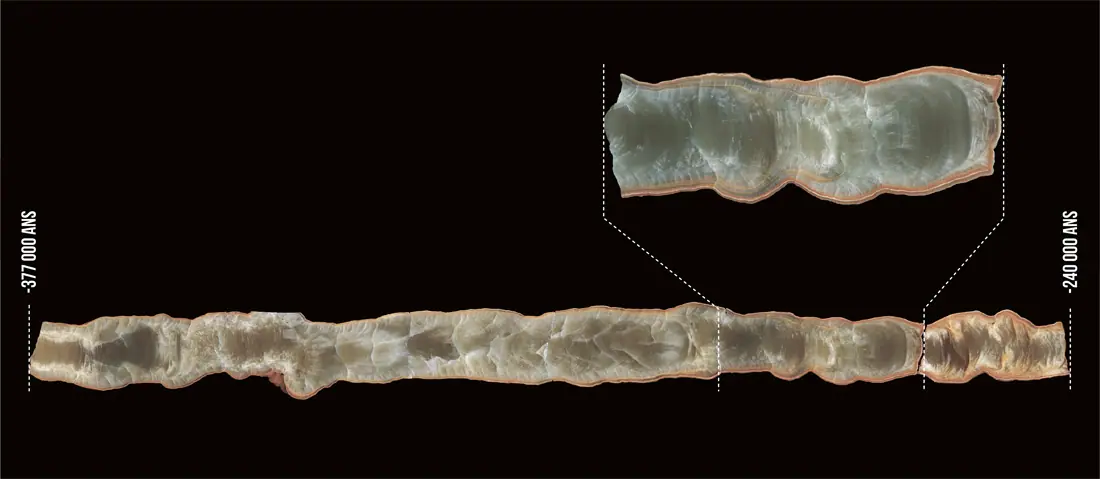
Photo of the Clam-stm7 stalactite
More Than 100,000 Years of Climate History Recorded at Clamouse
Between approximately 377,000 and 240,000 years ago, the Clam-stm7 stalagmite recorded several major climate fluctuations.
This period comprises several cycles characterized by alternating glacial and interglacial periods. In particular, the study of the stalagmite confirmed the presence of warmer and wetter interglacial phases.
The data obtained at Clamouse can be compared to other natural climate archives, particularly records from Antarctic ice cores.
The curves show a strong resemblance to one another: the variations recorded in the stalagmite reflect the major climatic fluctuations observed in the ice core records. But the significance of cave concretions does not end there.
Thanks to the accuracy of calcite dating, stalagmites provide additional information about the pace and rate of climate change, particularly during transitions between glacial and interglacial periods.
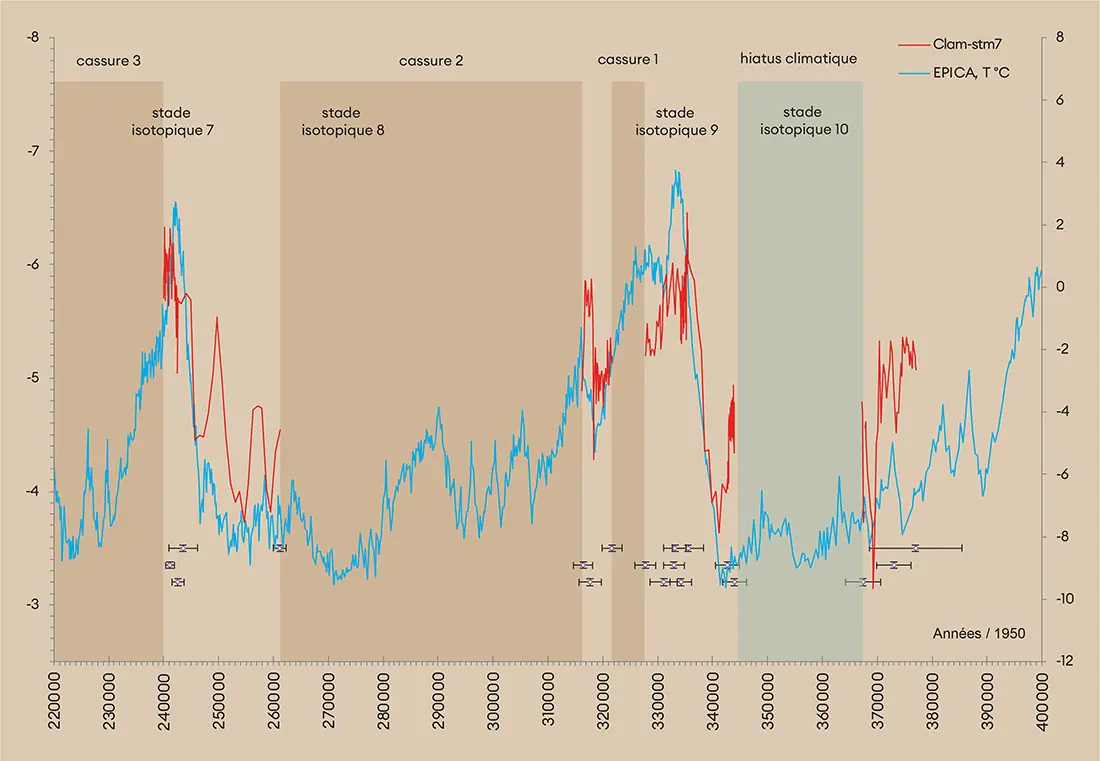
Graph showing a superimposition of data recorded on the Clam-stm7 stalactite and on Arctic core samples.
What do caves tell us about climate change?
The study of concretions therefore allows us to go back very far in time and examine climate changes that occurred long before modern meteorological measurements began.
For this reason, caves serve as particularly valuable paleoclimate archives. They allow scientists to cross-reference various sources of information: stalagmites, ice cores, sediments, pollen, and other geological markers.
At Clamouse, the Clam-stm7 stalagmite demonstrates that these formations are not only remarkable for their beauty; they also serve as valuable records of Earth’s climate history.
When observing a stalagmite, we can therefore see much more than just a succession of mineral layers: we can find traces of changes in temperature, humidity, and water flow that have shaped the landscape outside over hundreds of thousands of years.
The Clamouse Cave: A Blend of Natural Heritage and Scientific Research
The Clamouse Cave thus offers a remarkable example of how underground heritage can contribute to scientific knowledge. Its stalactites and stalagmites tell the geological and climatic history of the mountain range and bear witness to the slow evolution of karst landscapes.
This scientific aspect complements the tourist experience of exploring the cave: behind every stalagmite, every stalactite, and every flowstone formation lies a story that can sometimes date back several hundred thousand years.
Stay informed
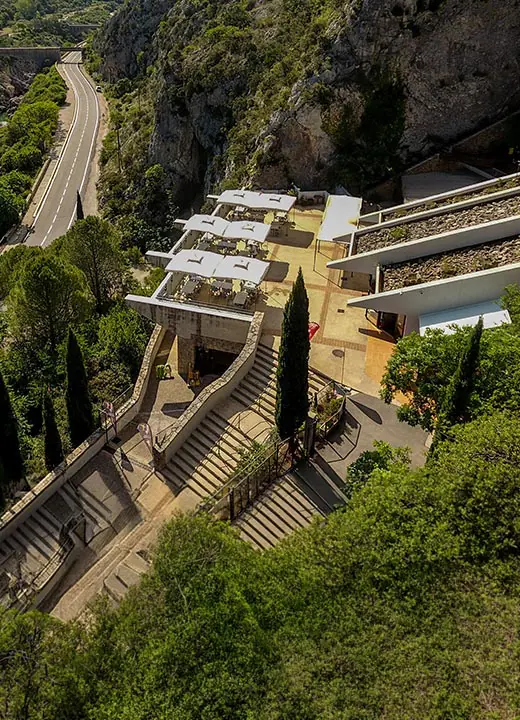
The Clamouse Cave, a pioneer in sustainable tourism in Occitanie
For more than ten years, the Clamouse Cave has been committed to preserving natural heritage and promoting social responsibility.

ConcertSolar Punk
Clamouse is transforming into a space for sonic exploration: join us for SOLARPUNK: The Awakening of the Senses.
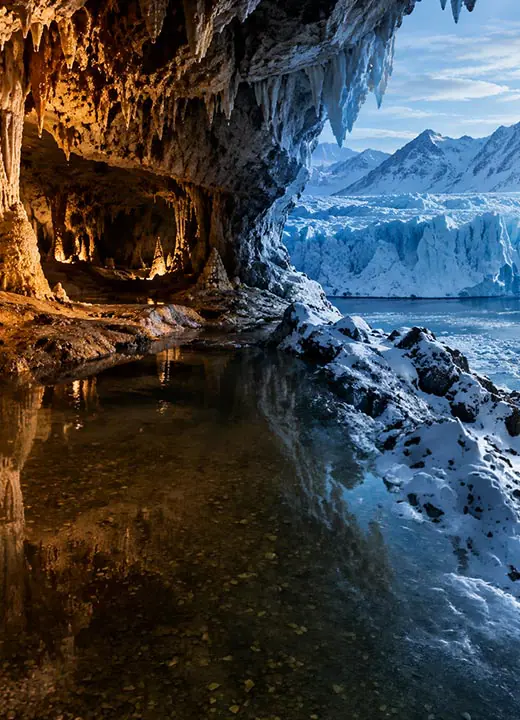
The caves,Witnesses to the Climates
Over the course of thousands of years, stalagmites and other mineral formations record changes in the environment.